From interview with the Architect Fernando González Rico.
In 1950, Héctor Gonzales Guevara founded the Tradezar furniture factory in Puente Aranda, a 500-square-meter space dedicated to "tradition, distinction, and art." He was the son of a carpenter and proudly represents a fine cabinetmaker.
He never opened a store, and his clientele included many Jewish families across the country. He created exclusive designs for each client in Colombia and some in the United States. His bedrooms, dining rooms, and living rooms competed in quality and design with Camacho Roldan & Co., the most important furniture company of the time.
Olga De Amaral began her artistic career designing furniture for Tradezar. She later dedicated herself fully to rug design and weaving, achieving great success.
Héctor's son, Fernando Gonzalez Rico (1950), learned to draw using sawdust and wood. He demonstrated his vocation as an architect from a very early age, making sketches and drawings of furniture in his father's cabinetmaking shop.
The factory lasted until 1965. Fernando wanted to take advantage of the know-how and expand the carpentry business into a furniture factory with production lines. Many of his workers came from other factories, such as Artecto and Camacho Roldan, a practice widely practiced in the furniture industry. But his father closed the company and wanted his son to study electronics, which was seen as the career of the future. So he enrolled at La Javeriana in 1967. It was a very demanding program, and students had to have an average of 4 out of 5.
In the third semester, he got a 3.9 and in the fourth semester, a 3.8, and he was dropped from the program. He enrolled in business administration at Tadeo, where he completed two semesters. His father stopped paying for it because he felt it wasn't a serious program. He then enrolled in architecture at La Javeriana, where he took many electronics classes. He worked to support his studies for the last two years with architect Enrique Hernandez Porras.
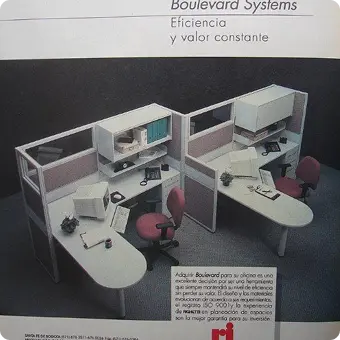
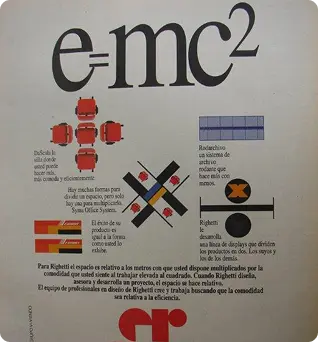
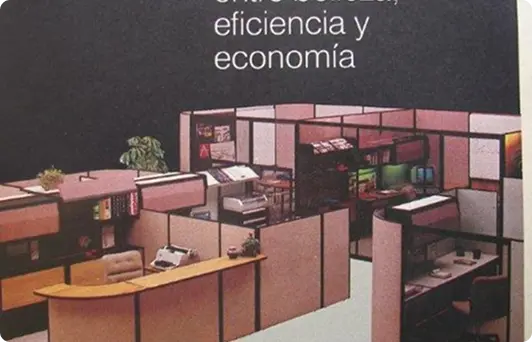
After graduating, he worked at Steven Wood Floors, setting up a prefabricated housing company, but that wasn't going well. When he saw an ad in the newspaper looking for an architect, he applied and was hired by Righuetti. Righuetti was a stand manufacturer that set up fairs and exhibitions throughout Latin America. Mr. Righuetti was Swiss and settled in Mexico, where he married a Colombian woman. They made ads for all the airlines in Mexico. He sent stands to Latin America, and that's why they were looking for an architect.
While at Righuetti, he had a meteoric career, starting out as a messenger architect, a draftsman who produced excellent hand-drawn layouts using a floormaster, and designing stands and displays. Sometimes they built a warehouse or a jewelry store, using the Swiss Syma System.
The two most important manufacturers of collapsible aluminum systems for making stands, including collapsible buildings, are Octanorm from Germany and Syma Sistem from Switzerland. With Syma System, you can make anything from a small table to a two-story collapsible building based on a fitting that you tighten with an Allen or Bristol wrench. It contracts and tightens or loosens for assembly or disassembly.
A year after joining Righuetti, in 1980, a person from Monterrey told Righuetti that Herman Miller was looking for a partner in Mexico to produce office furniture. Righetti became interested and became a partner with Herman Miller in Mexico. They purchased Cyma's know-how in Mexico and Colombia, and ordered molds for their desired products to extrude the aluminum parts they used.
Meanwhile, Herman Miller launched its Action Office open-plan office system, designed by Robert Probst and manufactured under license by Multiproyectos, pioneers in the Open Office system in Colombia, who did the hard work of introducing this new concept to the country.
Fernando Gonzalez, 28, was already the general manager of Righuetti in Colombia when Herman Miller's Action Office came onto the market. He became obsessed with the open office system. A completely new concept in Colombia. His background was carpentry and furniture, and he hired industrial designers, using Syma System profiles to design a system that didn't quite work as they wanted. Finally, they hired German Garcia, who came from Multiproyectos and understood what an open office system was. With him as Design Director, they developed a local system with all the information they had. "We used to say it was a Swiss system because we had elements from Syma System from Switzerland."
Righuetti in Colombia wasn't a real factory; they only had a panel board cutter; the rest was made outside. The story that "we were Swiss" caught on, and they positioned themselves above almost all companies in the country. Carvajal with Multiespacio had already begun producing open-plan offices; Demarka had the Stephens system by Knoll; Hunter Douglas with Billy Escobar's Quatro system; and Teka and its Teka System. Multiproyectos with Action Office was the most important of all. In addition, many other open-plan office manufacturers emerged in the country.
The office chairs were supplied by Series, a company founded by Mauricio Olarte that is a model in Colombia and the world for its penetration in the global market of concert venues, churches, movie theaters, etc. The sofas and armchairs were purchased from Lucy de Vergara of Condiseño, now Ziente, another company that is a pride of the country for its export furniture in leather and wood.
Righuetti enjoyed impressive commercial success. "We invented a story that everyone believed, that we were the best and most advanced in the development of design." After German Garcia, Rafael Sañudo, an industrial designer, later became director of design at Multiproyectos and later joined Righuetti. The design team worked on each project down to the smallest detail: layout, height, lighting, wiring, and maximum use of space. They had a system philosophy, and that was essential when selling and delivering a project. Maria del Rosario Rueda was the commercial director; they had offices in Medellín with Gloria Inés Cardona.
They had a system that competed for 19 years and took it to nine countries where they distributed with different partners: Mexico, Venezuela, Costa Rica, Panama, Ecuador, Peru, Chile, the Dominican Republic, and Colombia. Fernando founded a design company in Guadalajara and Mexico City, selling projects accompanied by Herman Miller furniture, and they managed to account for 34% of Herman Miller sales in Mexico. He met with Mr. Righuetti only once a year in each country.
Herman Miller ended up buying the 51% from Righuetti, which he had at the company in Mexico, and distribution in Guadalajara was closed.
Herman Miller expressed interest in buying Righetti due to the importance of its commercial structure. "We had a true university producing commercial people; the best people on the market today were trained at Righetti. We were absurd commercial beasts."
To take advantage of all their experience and commercial potential, Fernando Gonzalez, as Vice President of Righuetti International Corporation, decided to present to the Board a project to design, implement, and manufacture a new office system, which they named Askar 2000. They built a 600-square-meter space at Righuetti, brought in systems from Hayworth, Steelcase, Teknion, and the latest from Herman Miller, and dismantled everything. "We were looking to develop a completely new system to enter the American market, producing on a large scale."
They had to set up a real factory with all the necessary machinery for carpentry, upholstery, metalworking, and more, all using state-of-the-art numerical control. To achieve this, Fernando visited the country's leading furniture companies and consulted with a German machinery expert. They also had to set up a construction scheduling system and handle projects from nine countries plus the United States, according to the plan. When the entire project was presented to the Board, the Board rejected it. Highly discouraged, Fernando Gonzalez resigned from the company, and it quickly closed its doors.