Conversations with Urs Schmid.
Among the European figures who came to Colombia in the 20th century and exerted a great influence on both design and architecture, as well as on furniture technology and manufacturing, is Victor Schmid. Born in St'galle, Switzerland, in 1909, he studied cabinetmaking and forging in his hometown. In 1926, he moved to Cologne, Germany, where he studied architecture for four years at a trade school, supervised by Domenicus Bernu, Gropuis' alternate professor at the Bauhaus.
By order of Hitler, all foreign students left Germany. He returned to Switzerland, where he opened his architectural practice and built 14 houses. He not only built the houses but also designed and manufactured the lamps and much of the furniture.
Knowing that war was approaching, and already married, an aunt living in Rio de Janeiro invited him to Brazil. Enthusiastic about the idea, he set sail from Genoa in 1939 on the Conte Biancamano steamship. The last civilian ocean liner to sail from the port at the time. They reached Curaçao and then Panama. There, he was detained, but managed to escape and reach Buenaventura, where he was stationed.
During the voyage, he met the Swiss Consul Walter Ruthisberger, who invited him to Bogotá. In Buenaventura, he fell in love with black people, whom he saw as Prussian blue due to his colorblindness. They embarked on a truck that came with the ship, embarking on a journey that was an odyssey, exploring towns, colonial architecture, and folklore.
The Consul was his first client when he designed and built his house. He contacted the German colony and built several houses for them. At that time, there was the Maria de Fusagasugá prison, where Germans were imprisoned because Colombia supported the Allies in the war. We had a kind of concentration camp.
From that time on, he began designing and building furniture. Rolf Binder, a German organ maker, was mentored by Mr. Schmid in his workshop, where they made furniture for homes. Mr. Binder, an expert cabinetmaker, contributed greatly to the furniture factory's technology.
I also work with Werner Bierman, who arrived in Bogotá in 1938 and was another driving force behind the furniture industry in Colombia.
In 1948, he finished building and equipping a hotel in downtown Bogotá, which was burned and destroyed by the Bogotazo mob. Since the owner, a Spanish gentleman named Roca, couldn't pay him, he was left bankrupt. His wife, Lyda Schmid, set up a small store in the house, where she sold the furniture and lamps her husband made, and with that money they paid off their debts. The woman, who had a PhD in philosophy, took advantage of her friendship with all the ladies of Bogotá society and, through her store, "Casa Schmid," made them her regular customers. They began calling it the Swiss House, and many carpenters copied its models and started several businesses with Swiss names. A large number of carpentry shops were formed that still produce Swiss furniture under different names.
When he designed the Helvetia school in 1951, he was very specific about the sizes or measurements of the students for the manufacture of furniture.
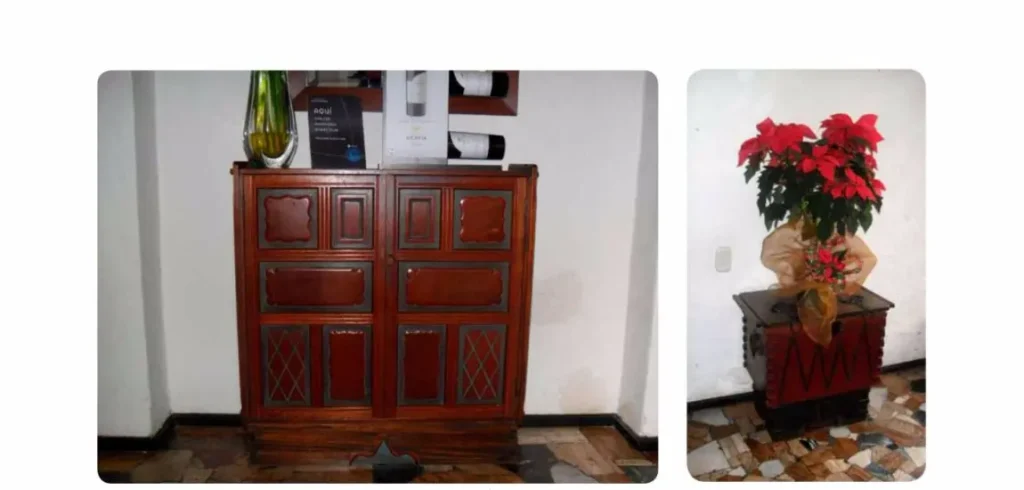
Many of its houses are preserved as part of the country's architectural heritage. Their furniture is an integral part of those warm, dark spaces that convey tranquility and peace, inviting you to light the fireplace. They are heavy, solid, rounded, and made of rustic wood, aged since they were made. The furniture is very comfortable. It's a pleasure to curl up and read, chat, or listen to music.
He was the creator of environments in which architecture, light and furniture formed a whole.
His influence is part of the Bogotá atmosphere that still permeates many homes and clubs.
Oscar D. Muñoz G.