When I was studying Industrial Design at the Scuola Statale D'arte in Florence (1970) we were taken to the Design Center in London and there I discovered the polyprop chair (1963) by Robin Day, the first chair injected in polypropylene, inspired by the fiberglass chairs of Charles and Ray Eames, but very cheap.
Polypropylene had only recently come onto the market, and one mold could produce up to 4,000 chairs in a week.
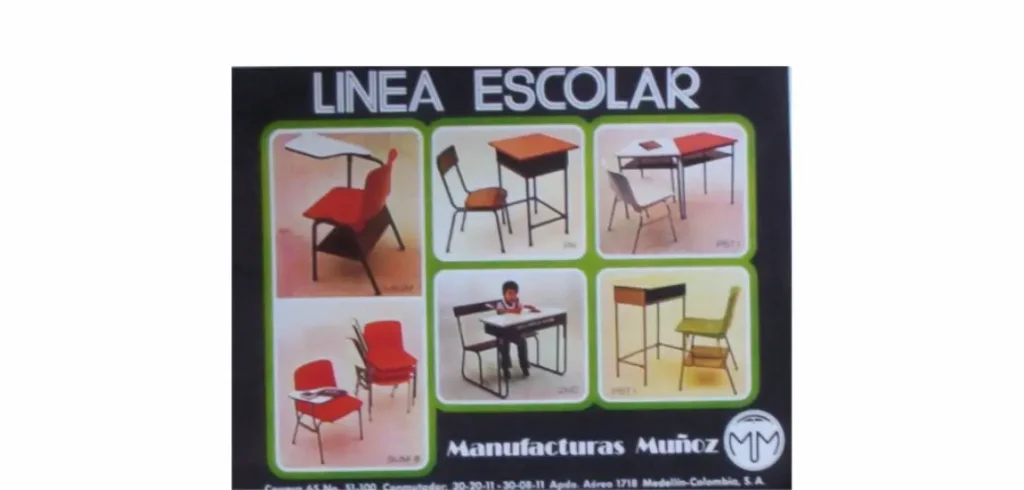
It was 1971 and chair production at Manufacturas Muñoz, now MUMA, was very artisanal and slow. We received more orders every day. I told my dad about the chair and asked Mares in Barcelona for a quote for the mold, but the price was exorbitant for the size of the company. Telephone calls were extremely expensive, so everything was done by airmail. Within two weeks, I had a reply. Mr. Mares asked me how many chairs we produced a year, and when I exaggerated, suggesting 15,000, he wrote back to me that a mold wasn't justified at that quantity, as the production cost was only a month, and molds had to be worked on up to 24 hours a day, all year round, to offset the high costs.
I explained that we weren't selling more chairs because we didn't produce them, but that we were capable of selling many more.
I told a cousin who worked at Imusa about a factory that injected plastic, and he assured me that they were capable of making the mold. No one imagined the difficulties that would entail, manufacturing a 4-ton mold with the technology available in Medellín at that time.
At first, a steel block of that size and specifications couldn't be obtained. So the engineers came up with the idea of casting the two parts of the mold following the plans I'd made for the chair (by hand, of course), and then carving out the cavities. Not even in science fiction did we think of computer programs as an aid for this work in 1972. The final leather-like finish was done manually with a motor tool.
After two years of dedicated work, we launched the first injected polypropylene Butterfly chair in the entire American continent in 1974. Although it was much cheaper than having it manufactured in Spain, the total cost was high for us.
My father believed in innovation and the company's future, allowing this investment in a chair that was completely alien to the environment. Who wants a plastic chair? How is plastic going to replace wood or metal? They break; plastic is synonymous with being cheap and disposable. These were some of the arguments we had to deal with, with one problem: the first chairs did break. Even though we used copolymer polypropylene, we had no idea about the qualities and proportions. We also had to learn about additives for ultraviolet rays and colorfastness.
What Imusa injected were combs, toys, plates, glasses, buckets and small household utensils that were never subjected to the use and strain of a school chair or a cafeteria chair, which worked all day, every day.
But little by little, we managed to solve all the problems, including the finishing: Since the saddle was hand-engraved, some strands would stick to our clothing, causing discomfort. To remove them, we had to flame the saddle.
It also had a small deflection in the backrest that no one noticed but that bothered me every time I saw it.
We overcame difficulties, and as people gained confidence in the chair, it began to sell in large quantities. I made structures for armchairs, swivel chairs, boat chairs, bus chairs, university chairs, sports arena chairs, etc. It was crazy; we sold 100,000 in one year. My father used to call them Butterfly because they flew away. It was also the first chair with a name, and it became generic; it was synonymous with plastic chairs.
Estra Industries quickly brought a mold to inject Robin Day's chair from Colombia, but ours had a great advantage: the grip design that hugged the frame tube without the need for screws. We added a pop rivet to prevent the chair from being removed.
Estra's chair was good competition because people could evaluate and choose.
The butterfly chair has been exported to the United States, Panama, Venezuela, Ecuador, and Peru.
The mold manufactured by Imusa began to break down after just two years, and I remembered Mares saying that their mold was guaranteed to last 1 million chairs. So we decided to have a new mold manufactured in Barcelona, which arrived in early 1978 and continues to produce butterflies, almost 40 years later.
Then, based on the Butterfly, I designed the Alcatraz module for the hamburger chain, Presto.
They wanted an American-style booth that could seat four people, but without upholstery, light and easy to maintain. This is perhaps the design that has been copied the most. It came out around 1976 and is still being produced for almost all the coffee shops in the country.