On March 13, 1913, Don Eleazar Ospina founded a mechanics and foundry workshop in Medellín. He had studied at the Pedro Justo Berrio School of Arts and Crafts, run by the Salesian fathers. His main product was the manufacture of bells; he also produced pots, pans, and stirrups.
In 1922, a fire destroyed the warehouses on the western side of Berrio Park, where the Oquendo flea market was located. These beds were made of pipes. The pipes were joined by cast-iron rosettes, which melted in the heat of the fire, and the beds fell apart. They called Don Eleazar to see if he could fix them, and he made the molds, poured the molten metal, and assembled the beds. They painted them, and they were as good as new. Thus began the manufacture of metal furniture.
At that time, he worked with two of his sons, Francisco and Antonio. The company grew rapidly, making beds, and in 1927, Francisco embarked for New York to acquire knowledge in the field. He sought out a Jewish-owned metal furniture factory and worked there for two years, practicing all the trades and learning. Meanwhile, his father obtained a five-year loan of $5,000 from Mr. and Mrs. Caycedo of Cali to purchase the machinery Francisco had chosen there. They repaid the loan in three years.
Lathes, tube bending machines, sheet metal cutters and benders, painting equipment, die cutters, welders. The latest technology arrived in Puerto Berrio by ship and then by train to Cisneros station in Medellín. Since the workshop was nearby, they obtained some rollers, set up the machines, and pushed them to the warehouse at 45th Street A, 54-34, Maturín, near Cúcuta, beginning an era of development and expansion nationwide.
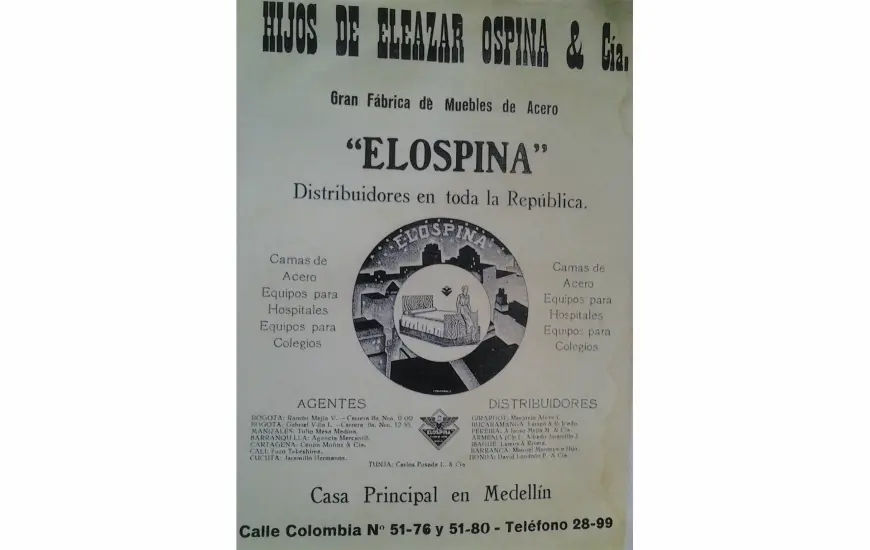
Ignacio Ospina's sons, Ignacio and Gabriel, founded the Icam factory in 1972. They all made the same furniture.
In 1978 Elospina Bogotá closed.
In 1981-82 Elospina Medellín closed.
In 1985 Icam closed
The design of the pipe desks shows a Bauhaus influence that was very fashionable at the time.
Bed decoration in the early 1930s and 1940s was entirely handmade, with beautiful geometric motifs or imitation wood grain on the slats of beds, cribs, and nightstands, always in subdued colors. Some cribs even have a built-in display case.
In the early years all materials were imported: sheet metal, pipes, angles, rods.
Since the 1940s, they launched a hospital line, adapting imported furniture to their production system with very good results for the time.
The wheelchairs are beautiful with very simple and practical mechanisms, as are the dental chairs.
School furniture made of steel angles or tubing, sturdy and heavy; certainly uncomfortable but very durable, with solid wood tops, seats, and backrests.
The office line: Desks made of bent pipes, very Bauhaus-style.
Desks in sheet metal with a decorative wood-effect finish
The cantilever chairs are made of 16 gauge or heavier steel tubing to withstand extended use, mimicking the chairs of Mies Van de Rohe, Marcel Breuer, and Mart Stam from 1926 to 1932.
They came to have 250 workers.
They were mass-produced furniture of very good quality and affordable prices that lasted a lifetime with minimal maintenance.
They had distributors all over the country.